We recognize that the preservation of the global environment and symbiosis with nature are in harmony with our business plan and are fundamental obligations.
Our three declarations made in October 1996 ("Global Expansion" "Health-consciousness" "Eco-friendliness") are part of our corporate ethics and we will disclose this universally.
While offering products and services that contribute to society, we will make consideration of the environment an essential task.
While following societal norms, we will use our power to harmoniously promote sustainable development.
Environmental Policy
Our Course of Action
To contribute to a sustainable society, we are committed to preserving and enhancing the environment throughout all stages of our tool lifecycle from development and design to disposal. We promote a circular economy through the effective use of resources and waste, and advance energy conservation and renewable energy. Additionally, we strive to provide environmentally conscious products.
We will strive for continuous improvement and pollution prevention.
While complying with environmental laws and other requirements, we will bear the responsibility for and manage all business activities that have an impact on the environment, and strive to elevate our level of social responsibility.
Our environmental goals and targets will be based on environmental laws, environmental concerns, and the ideas of stakeholders. These goals will be adjusted annually.
We strive to reduce environmental impact and promote biodiversity through our environmental activities.
This policy is the foundation of our environmental management system, and through maintaining it, it will become common knowledge to all employees.
Environmental Management
Environmental Management Structure
OSG has formulated a company-wide environmental strategy and established an "Environmental Headquarters Committee" to proactively address environmental issues. The environmental management system is led by the departments close to the work site, which have a large environmental impact. The environmental management activities are organized by the director in charge of the environment as top management and the general manager of the Quality Assurance Department as the overall environmental management representative.
Environmental Management System
Environmental Performance and Targets
At OSG, we formulate a Medium-Term Environmental Plan every three years. Fiscal year 2025 marked the first year of the 10th Medium-Term Environmental Plan. We worked toward achieving our targets under three key management indicators: (1) Eco-Factory (environmentally friendly manufacturing),(2) Eco-Products (development of environmentally friendly products), (3) Energy improvement and reduction. As a result of these efforts, we successfully achieved all three management indicators.
Mid-Term Environmental Plan Targets & Performance
10th Medium-Term Environmental Plan
No
Environmental Objectives
FY2025
FY2026
FY2027
Item
Description
Achievements
Targets
Targets
1
Eco-Factory
Eco-friendly manufacturing (100 pts. max)*
50 pts. (average)
44 pts.
48 pts.
2
Eco-Products
Develop eco-friendly products (60 pts. max)*
43 pts.(average)
43 pts.
45 pts.
3
Energy improvement and reduced usage
Energy-saving activities for energy sources (electricity, LP gas)
Reference values:
FY24 average monthly electricity, LP gas usage: 93,632 GJ
1.7% cut
(cumulative) vs.
FY24 monthly average
2% cut
(cumulative)
1,873
[GJ/year]
3% cut
(cumulative)
2,809
[GJ/year]
*Standards set by the Japan Cutting & Wear-Resistant Tool Association have been adopted for assessing Eco-factories (highest score: 100 pts.) and Eco-products (highest score: 60 pts.).
The design/development, manufacture and servicing (supply of technical data, technical guidance, calibration) of cutting tools, forming tools, measuring tools, non-wire coater bar, driver bits, special and original machines and tools.
Management of Environmentally Hazardous Substances
As part of our efforts to prevent contamination, each of our sites conducts emergency training and drills to verify countermeasures to be employed when there is an oil spill or leak. In conjunction with these initiatives, we have ascertained those chemical substances handled in our production processes that are subject to controls under the PRTR system. We have also identified the amounts of six controlled chemical substances (see diagram at right): chromium, molybdenum, cobalt, vanadium, manganese, and nickel.
FY2025 PRTR chemical substances
Environmental Data
Environmental Accounting
OSG's environmental accounting system references the Environmental Accounting Guidelines established by the Ministry of the Environment. Our aim to present an environmental accounting to facilitate understanding of our philosophy and environmental conservation efforts so as to improve our relationship with society.
Costs and Effects over the Past Three Years
[1,000 yen]
FY2023
FY2024
FY2025
1.Positive costs
52,026
111,334
606,674
2.Maintenance costs
76,406
78,746
84,286
3.Environmental damage compensation
0
0
0
4.Environmental conservation loss
32,501
56,342
33,838
Detailed Accounting of Costs and Effects in FY2025
■Costs
[1,000 yen]
Category
Item
Specific initiatives
Investments in equipment, etc.
1. Positive costs for achieving environmental targets
①Pollution prevention costs
-
0
②Global environmental conservation costs
Updating heat source devices, transformers and air conditioning units, converting to LED lighting, etc.
514,423
③Resource environmental costs
-
0
④CO2-free electricity purchase costs
-
92,251
Subtotal 606,674
2. Environmental management system maintenance costs
①Labor costs associated with environmental conservation activities
Various environmental measurement and analysis expenses
649
⑦Environmental conservation costs associated with social activities
Japan Cutting & Wear-resistant Tool Association Environment Committee activity expenses
0
Subtotal 84,286
3. Compensation costs for environmental loss
Costs for soil remediation, restoration after destruction of nature, etc.
-
0
Subtotal 0
Total 690,960
■Effects
Category
Item
Specific initiatives
Investments in equipment, etc.
4. Environmental conservation effect
Total environmental improvement effect
Energy savings achieved by updating heat source devices, transformers, and air conditioning units, as well as converting to LED lighting
33,838
Total 33,838
Energy usage
CO2 emissions
Waste emissions and ratio of valuable materials
Drainage water volume
Material Balance in Operations
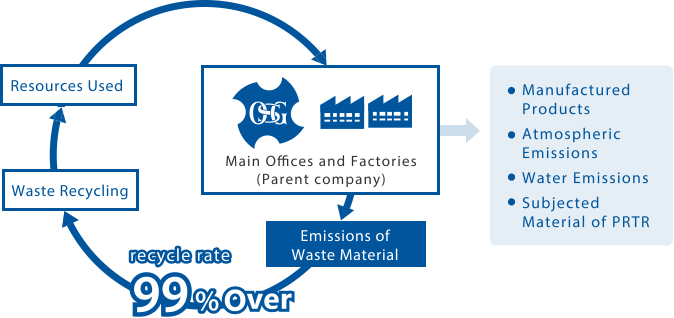
To contribute to the realization of a low-carbon society and the creation of a resource-recycling society, OSG ascertains and manages the various environmental impacts of our business activities. We continually strive to manage these effects with initiatives, such as reducing energy usage and putting waste from our manufacturing processes to use as recycled material.
Carbon Neutrality
Governance & Risk Management
At OSG, the Risk and Compliance Management Committee evaluates the priority of climate change and other risks affecting us overall, based on their impact on our business. The Sustainability Committee, the Risk and Compliance Management Committee, and the Safety and Health Committee operate in conjunction with each other to monitor risks and opportunities associated with climate change. The Sustainability Committee deliberates on matters including ESG-related issues, the enforcement of policies and visions, and priority measures, and regularly reports on its activities to the Board of Directors.
Sustainability Promotion Structure
Sustainability Committee Meetings in the Fiscal Year Under Review
Date
Main items reported, etc.
April 10
Progress report on initiatives for carbon neutrality (carbon footprint calculation)
July 10
Progress report on initiatives for carbon neutrality (relationship of Scope 2 to production and ongoing metrics)
October 9
Progress report on initiatives for carbon neutrality (future prospects and recycled plastic cases)
January 8
Report on 2025 initiatives for carbon neutrality and the plan for FY2026
Risks and Opportunities
We selected scenarios involving temperature rises of 1.5°C and 4.0°C, and reviewed risks, opportunities, and our responses.
Scenarios referenced: 1.5°C scenario (IEA NZE2050) and 4°C scenario (IPCC RCP 8.5) among others
We identified three points in particular as key risks exerting a high degree of influence: Cost increases due to the tightening of GHG regulations, decreased demand for tools for gasoline-powered vehicles due to the accelerating shift to electric vehicles, and damage to suppliers due to intensifying extreme weather.
To address these, we are undertaking medium- to long-term actions including energy conservation, the introduction of renewable energy, review of our business portfolio, diversification of suppliers, and strengthening of our BCP, with the aim of enhancing our resilience. In particular, we recognize the proliferation of renewable energy and energy-saving technologies and the expansion of the EV and storage battery markets as key opportunities, so we view climate change as an opportunity for business growth. To take advantage of these opportunities, we are strengthening our development of energy-saving-related and renewable energy-related tools, expanding our investment in the micro and precision machining field, and boosting quality and sales of our long-life tools. We are also increasing the transparency of our corporate activities through proactive information disclosure, while connecting the movement toward a low-carbon society to greater competitiveness.
Risks and Countermeasures
Type
Subcategory
Risks
Impact
Response
Transition risks
Policies & legal restrictions
Tighter regulations on GHG emissions
Increase in manufacturing, development, production and procurement costs due to carbon taxes and other charges
High
Set targets for reduction of CO2 emissions
Implement off-site PPA, and on-site PPA
Purchase CO2-free electricity at factories
Promote eco-factories (enhance energy-efficiency of OSG-manufactured machine tools, improve equipment operation and visualize energy consumption)
Tighter regulations on fossil fuel power generation
Decrease in demand and increase in development and manufacturing costs for tools on account of fossil fuel power generation
Moderate
Reassess manufactured items in light of changes in target markets
Technology
Dissemination of renewable energy and energy-saving technologies
Increase in development and manufacturing costs
Moderate
Scrutinize renewable energy market trends Survey and assess equipment, etc. that mitigates cost increases
Markets
Transition to eco-friendly products
Decrease in sales of non-ecofriendly products and services
Moderate
Develop eco-friendly cutting tools
Expansion of electric & fuel-cell vehicles
Decrease in demand for tools for gasoline-powered vehicles
High
Commit resources to developing and designing for markets other than gasoline-powered vehicles
Reputation
Changes in customer base and investors
Decline in corporate value and loss of opportunities for securing orders due to insufficient disclosure of non-financial information
Moderate
Proactively disclose information and reply to CDP questions
Contraction of scale of eco-unfriendly business
Moderate
Optimize our business portfolio
Increase in financing procurement costs
Moderate
Adopt ESG/SDGs assessment-based financing
Physical risks
Acute
Increased severity of extreme weather events
Increase in procurement costs due to reassessment of suppliers
Moderate
Review BCPs for all suppliers (ascertain risks affecting suppliers in terms of natural disasters, logistics, raw material procurement, etc.)
Difficulty in procuring materials, production shutdowns, and production delays due to disasters affecting suppliers
High
Diversify suppliers
Damage to production facilities, production shutdowns/delays, discharge of toxic substances due to damage to OSG plants
Moderate
Draft and revise BCP, implement concrete facility countermeasures, diversify production sites, and thoroughly control hazardous and other such substances
Chronic
Rise in mean temperatures
Increase in energy for air conditioning
Moderate
Adopt high-efficiency air conditioners
Deterioration in employee working conditions
Moderate
Promote labor savings and automation at factories (automated measuring and packaging), promote safety and health management, improve thermal environment inside factories
Production shutdowns due to shortage of electricity or water
Moderate
Introduce in-house power generation facilities and storage batteries, and reduce electricity and water usage at factories and offices
Note: Timeline ranging from 2030 to 2050 is assumed.
Opportunities and Responses
Type
Subcategory
Opportunities
Impact
Response
Transition risks
Policies & legal restrictions
Tighter regulations on GHG emissions
Investment hurdle lowered due to consolidation of internal carbon pricing (ICP) or the number of years for recouping investments incorporating carbon tax
High
Adopt internal carbon pricing
Technology
Dissemination of renewable energy and energy-saving technologies
Increase in demand for tools for renewable energy and energy-saving technologies
Moderate
Develop and increase sales of tools for energy-saving facilities and renewable energy-related items
Markets
Expansion of renewable energy
Increase in demand for energy projects such as development of solar panels and offshore wind power
Moderate
Develop and increase sales of tools for storage batteries, renewable energies, and hydrogen-related items
Transition to eco-friendly products
Expansion of demand for long tool life products
Moderate
Further enhance quality, development, and increased sales of long tool life products
Develop tools that enhance efficiency and shorten processing time
Expansion of electric & fuel-cell vehicles
Increase in demand for precision die machining due to promotion of battery development
High
Increase sales in the micro and precision machining sector
Increase in demand for EV chargers and storage batteries
High
Accelerate development of tools for EV chargers and storage batteries
Greater demand for micro and precision tools due to larger market for semiconductors, connectors, and electronic components
High
Develop, increase investment, and build sales of micro and precision tools
Reputation
Changes in customer base and investors
Improve evaluations by stakeholders through proactive information disclosure
Moderate
More proactive information disclosure
Physical risks
Acute
Increased severity of extreme weather events
Increase in demand for disaster prevention products, services, etc. for times when natural disasters strike
Moderate
Develop tools for disaster preparedness
Note: Timeline ranging from 2030 to 2050 is assumed.
Reduction of CO2 Emissions
Roadmap
The OSG Group has set a new Group-wide target for the reduction of CO2 emissions. We will steadily undertake initiatives based on plans, aiming for a 20% reduction in 2030 compared to FY2024.
While our emissions in FY2025 exceeded those of the previous fiscal year, to achieve our medium- to long-term target, we will analyze the variable factors behind emissions and undertake continuous improvements to reduce CO2 emissions.
CO2 Emissions Reduction Roadmap (Scope 1 & 2, consolidated)
Reduction Measures
The OSG Group is advancing measures under its Medium-Term Management Plan to address climate change.
Medium-Term Management Plan
Stage12022-2024 Start toward carbon neutrality
Cut CO2 emissions by 10% (vs. FY2019) Result: 19% reduction
Calculate Scope 1 & 2 (consolidated)
Introduce renewable energy ▶Off-site PPA ▶On-site PPA (Shinshiro Factory)
Stage22025-2027 Expand to Group-wide initiatives
Calculate Scope 3
Calculate carbon footprint
Consider introduction of additional renewable energy ▶Oike Factory ▶Other sites
Stage32028-2030 Promote Group-wide reductions
Cut CO2 emissions by 20%(vs. FY2024, consolidated)
Obtain SBT certification
Consider introduction of additional renewable energy ▶Consider next-generation solar panels, etc.
FY2026 plan
1. Introduce initiatives to reduce CO2 emissions (Scope 1 and 2) in manufacturing divisions
2. Introduce initiatives to reduce CO2 emissions (Scope 1 and 2) at Group companies
3. Calculate Scope 3
4. Consider rules for visualization and disclosure of carbon footprint
5. Prepare for the introduction of renewable energy
Adopt Renewables and Saving Energy Through More Efficient
Introduction of Renewable Energy
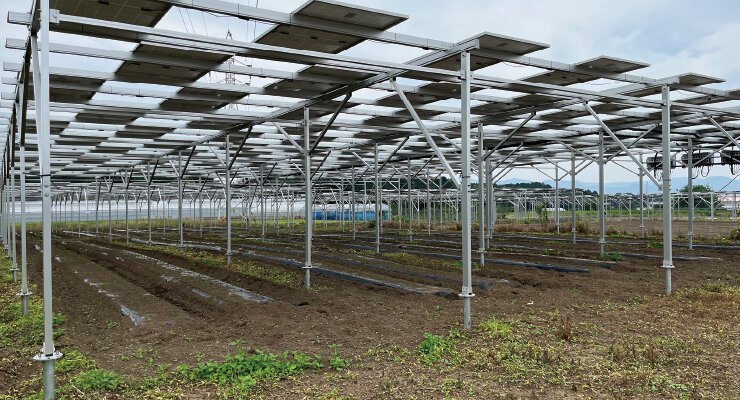
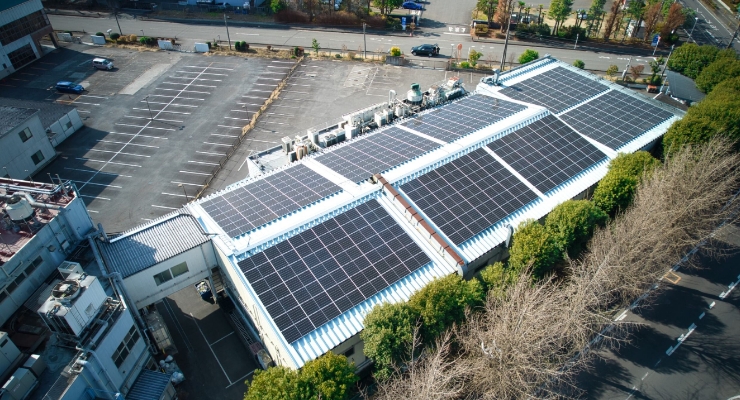
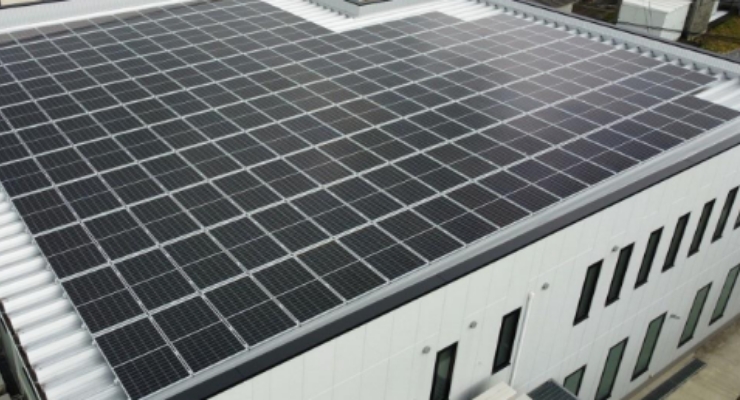
In December 2022, OSG entered into an agreement with Chubu Electric Power Miraiz Co., Inc. and Agri-Gascom Co., Ltd. to take steps toward implementing a farm-based off-site power purchasing agreement (PPA). Through this agreement, carbon-free electricity generated at a photovoltaic power plant for the exclusive use of OSG will be supplied for a period of 20 years. This is expected to reduce CO2 emissions by approximately 4,000 tons per year. Additionally, we expect to reduce CO2 emissions by approximately 600 tons through the use of CO2-free electricity (Chubu Electric Power Miraiz's "Green Denki"), and by approximately 300 tons annually through an on-site PPA at the Shinshiro Factory. These initiatives represent a reduction of approximately 10% in electricity consumption at our major domestic factories.
Furthermore, not only OSG on a standalone basis but also the entire OSG Group, including both domestic and overseas affiliated companies, is promoting the use of renewable energy. At present, renewable energy has been introduced at 12 companies worldwide.
We will continue to promote the use of electricity sourced from renewable energies as part of our efforts to contribute to realizing a carbon neutral society.
A Farm-based Off-site PPA
On-site PPA at Shinshiro Factory
On-site PPA at Nihon Hard Metal
On-site PPA at F.P.TOOLS
Energy Saving Activities
CASBEE Certification for the New Factory and Cafeteria Buildings at the Oike Plant and Energy-Saving Initiatives
Air conditioning systems account for a significant portion of electricity consumption in factories.
In recent years, climate change is expected to further increase cooling demand, raising concerns about higher electricity consumption.
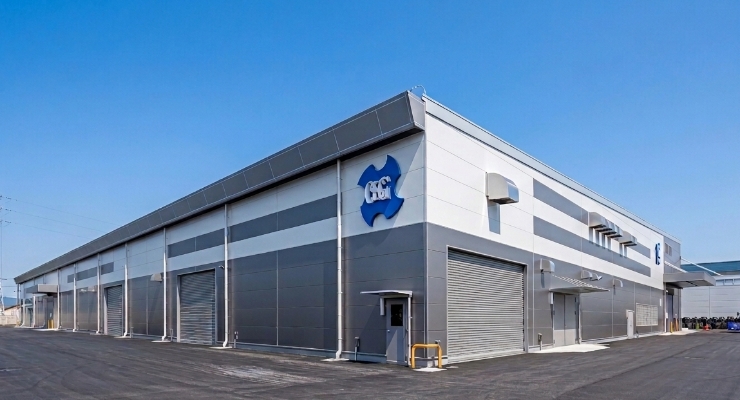
Against this backdrop, the Oike Plant adopted a design focused on reducing air conditioning loads in the reconstruction of its facilities, including the factory buildings.
As a result, both the new factory building and the new cafeteria building have obtained CASBEE (※) Aichi B+ certification.
At the new factory building, a double-layer insulated roof structure has been adopted to suppress heat loss throughout the building and reduce electricity consumption associated with air conditioning.
In addition, a centralized monitoring system has been introduced for air conditioning control, enabling integrated management of air conditioning equipment across buildings within the same site.
This has enabled early detection of malfunctions and abnormalities, appropriate control of operation and shutdown, and prevention of unnecessary operation, thereby reducing energy losses related to air conditioning.
From an operational perspective, initiatives such as automated temperature and humidity control within the factory, scheduled operation of air conditioning equipment, and the use of natural energy through outside air intake have been implemented to ensure thorough energy-saving operations.
Through these efforts, we have achieved both energy-efficient air conditioning operation and stable indoor temperature control, which has a significant impact on product quality.
(※) CASBEE (Comprehensive Assessment System for Built Environment Efficiency) is an indicator that comprehensively evaluates the environmental performance of buildings from perspectives such as energy efficiency, reduction of environmental impact, and indoor environmental quality. "CASBEE Aichi" is a certification system established by Aichi Prefecture to promote the spread of sustainable buildings.
Oike Factory - New Factory Building (Exterior)
Oike Factory - Cafeteria Building
Environmental Education
Environmental education is broadly divided into training for managers and supervisors, and training for all employees. The training for managers and supervisors helps participants better understand the ISO 14001 management system and develop the skills to serve as an internal auditor for environmental activities. In addition, so that more people will be involved as internal auditors, we are striving to increase the number of internal auditors and raise environmental awareness throughout OSG.
Education Training System
History of Environmental Activities
OSG
Group Company
Company
Factories
2010
OSG being awarded 4th Year's "Grand Prize" and "Environmental Contribution Award" by Japan Solid Cutting Tools' Association Environmental Awards.
Installation of inverter units to air condition units.
2011
OSG being awarded 5th Year's "Grand Prize" by Japan Solid Cutting Tools' Association Environmental Awards.
16 units completed the disposal of PCB minutes early registration.
2012
OSG being awarded 6th Year's "Grand Prize" and "Environmental Contribution Awards" by Japan Solid Cutting Tools' Association Environmental Awards.
2013
OSG being awarded 7th Year's "Grand Prize" and "Environmental Contribution Awards" by Japan Solid Cutting Tools' Association Environmental Awards.
2014
OSG being awarded 8th Year's "Environmental Honor Award" and "Environmental Contribution Awards" by Japan Solid Cutting Tools' Association Environmental Awards.
Updated from LPG air conditioning to electric chiller system.
Nihon Hard Metal Co., Ltd. headquarters and headquarters manufacturing plant acquired ISO14001 certification.
2015
Received the "2015 Environmental Improvement Activities Award" from the Japan Cutting & Wear-resistant Tool Association.
Disposal of PCB-containing materials.
2016
Received the "2016 Environmental Improvement Activities Award" from the Japan Cutting & Wear-resistant Tool Association.
2017
Received the "2017 Environmental Improvement Activities Award" from the Japan Cutting & Wear-resistant Tool Association.
OSG GmbH obtained ISO 14001
2019
Received the "2019 Environmental Improvement Activities Award" from the Japan Cutting & Wear-resistant Tool Association.
2020
Received the "2020 Special Environment Award / Environmental Improvement Activities Award" from the Japan Cutting & Wear-resistant Tool Association.
2021
Received the "2021 Environmental Improvement Activities Award" from Japan Cuting & Ware-resistant Total association.
2022
Received the "2022 Environmental Improvement Activities Award" from Japan Cuting & Ware-resistant Total association.
2023
Received the "2023 Environmental Improvement Activities Award" from Japan Cuting & Ware-resistant Total association.
2024
Received the "2024 Environmental Improvement Activities Award" from Japan Cuting & Ware-resistant Total association.
2025
Received the Grand Award at the 22nd 'CHO' MONODZUKURI Innovative Parts and Components Awards,2025(※1)
Received the Prize of the Chairman of the Energy Conservation Center, Japan at the 2025 Energy Conservation Grand Prize awards(※2)
Received the "2025 Environmental Improvement Activities Award" from Japan Cuting & Ware-resistant Total association.
(※1)Hosted by the MONODZUKURI Nihon Conference and the Nikkan Kogyo Shimbun, Ltd.
(※2)Hosted by the Energy Conservation Center, Japan; Product Category and Business Model Category
OSG
Group Company
Company
Factories
1996
Declared "Eco-Friendly Company"
Stopped using trichlorethylene
1997
OSG Korea obtained ISO 14001
1998
1999
Established "Environmental Policy"
2000
Nine offices received ISO 14001 certification
Installed new washer designed not to use methylene chloride in Shinshiro factory
OSG Coating Service obtained ISO 14001
2000
OSG System Products obtained ISO 14001
2001
Started to recycle diatomaceous soil used to filter waste oil
2001
Stopped using package made from chloroethene
2001
Abolished salt bath heat treatment
2002
Installed the ice thermal storage air conditioning system "Eco-Ice" in the headquarters
Carried out an inspection of hazardous substances in the packaging materials
OSG Brazil obtained ISO 14001
2002
Started conversion of factories to controlled temperature facilities
2002
Reduced incinerator to 1 unit from 3
2003
Carried out an inspection of hazardous substances in the all goods purchased
2004
Accomplished a recycle rate 98% in accordance with OSG Zero Emissions Plan
Abolished totally the combustion furnace
Noda Precision obtained ISO 14001
2005
Completed switching to chlorine-free grinding oil in Yana factory
Sanwa Seiki Shiga factory obtained ISO 1400
2006
Abolished all the wash-ers which use methylene chloride
Omori obtained KES
2006
Abandoned private power generators in Shinshiro, Toyohashi, and Oike factories
2007
OSG being awarded 1st year's "Grand Prize" and "Environmental Contribution Award" by Japan
Nihon Hard Metal Kyushu factory obtained ISO 14001
2007
Solid Cutting Tools' Association Environmental Awards.
Aoyama Seisakusho obtained ISO 14001
2008
OSG being awarded 2nd Year's "Grand Prize" and "Environmental Contribution Award" by Japan Solid Cutting Tools' Association Environmental Awards.
Completed switching to chlorine-free grinding oil in all factories
Ohtaka Seikoh factory obtained ISO14001.
2008
Taiho Sangyo obtained ISO14001.
2009
OSG being awarded "Environmental Special Award" by Japan Solid Cutting Tools' Association Environmental Awards.
YANA Factory switched the chiller system to "Top Runner" system on its Total Coolant System.
Eco-friendly Products
OSG engages in the development of products and new technology that can improve the machining efficiency and reduce the machining costs of our clients, and allow them to engage in environmentally-friendly machining that does not waste energy.
Recycling projects at our offices
OSG's major business locations actively promote recycling and the reduction of waste, and since FY2005 we have achieved a recycling rate of over 99%.
A high recycle rate aiming for a "Sustainable Society"
Resource Recycling Initiatives
OSG has been promoting zero emission activities to reduce waste. We have also developed a system to recycle reusable and recyclable resources and established a structure to ensure the proper disposal of waste from our operations. These efforts have enabled us to maintain a recycling rate of over 99% since 2005.
Recycling rate
[%]
FY2021
FY2022
FY2023
FY2024
FY2025
99.8
99.7
99.8
99.7
99.7
Weight of recycled materials
[t]
Resource Recycling Promotion
FY2024
FY2025
Metal scrap (sold)
770.8
783.7
Cardboard boxes (sold)
52.4
63.5
Waste oil (sold and recycled)
485.1
550.5
Oil sludge (sold and recycled)
168.8
192.6
Diatomaceous soil (sold and recycled)
316.2
298.7
Waste grinding wheels (sold and recycled)
35.6
34.9
Waste plastic (recycled)
44.1
49.4
Wood chips (recycled)
122.4
109.8
Other (recycled)
61.5
63.2
Plastic and other (sold)
4.1
10.5
Total resources recycled
2,061.0
2,156.8
Reducing Environmental Impact with Thorough Management of Waste and Visualization of CO2 Emissions
OSG is working to lower its environmental impact by improving how we manage waste and monitor CO2 emissions.
We've made our waste tracking system clearer, so we can see what types of waste we produce, how it's handled, and where it comes from.
This helps us follow regulations and understand our impact more accurately.
With this data, we're taking steps to reduce waste, increase recycling, and cut CO2 emissions.
We're also planning to connect waste and emission data to build a smarter, more sustainable system.
We are committed to contributing to a recycling-oriented society through environmentally conscious corporate activities.
Initiatives to Reduce Plastic Waste through Plastic Case Sorting
OSG is continuously working to reduce industrial waste generated at each of its business sites from the perspectives of environmental conservation and CO2 emissions reduction.
Among these efforts, we promote material recycling of waste plastics, aiming to reuse them as resources rather than relying on incineration or simple disposal.
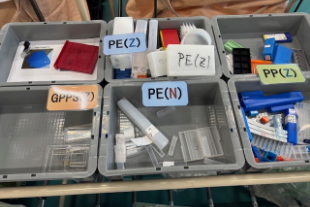
By carefully sorting waste plastics, it becomes possible for specialized recyclers to purchase them as valuable materials and recycle them.
We have established a sorting and collection system for rigid plastic packaging cases, returnable containers (such as bins and storage cases), and pallets.
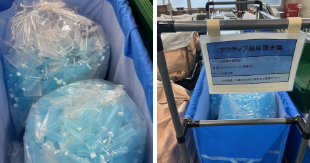
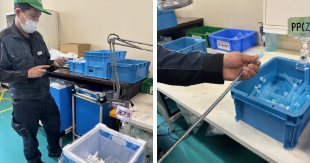
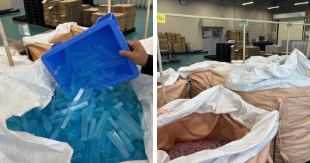
At the Shinshiro Factory, which has packaging processes, plastic cases and other items are dismantled and unnecessary components are removed in cooperation with OSG Active, a special subsidiary dedicated to employing persons with disabilities, to prepare them for shipment as recyclable materials.
As a result, the annual volume of collected plastic cases, returnable containers, and pallets at the Shinshiro Factory has reached 4.1 tons, and by directing these materials to material recycling, we have reduced CO2 emissions by 3.3 tons per year.
In addition, these efforts have enabled 28.4% of industrial waste (waste plastics) generated at the Shinshiro Plant to be converted to material recycling, thereby reducing the environmental impact associated with disposal.
Based on the results achieved at the Shinshiro Factory, we are expanding similar initiatives to the Oike Factory to further reduce plastic waste.
At the Oike Factory, approximately 8 tons of materials are expected to be collected annually, with an estimated reduction of about 6.5 tons of CO2 emissions per year.
Going forward, we will continue to advance resource circulation and reduce environmental impact by building on the experience gained through establishing on-site sorting systems, ensuring stable operations in collaboration with our special subsidiary, and carefully complying with relevant regulations for the collection and transportation of waste plastics. Through these efforts, we will contribute to the realization of a sustainable society.
Process from Discarded Packaging Cases to Recycled Materials
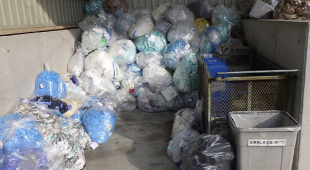
1Used plastic cases are collected.
2Various types of cases, including imported and in-house-used items, are sorted.
Cushioning materials such as sponges are removed, and the cases are dismantled into a recyclable state.
Sorted into five categories!
3Items of the same type are placed into large collection bags called "flexible container bags."
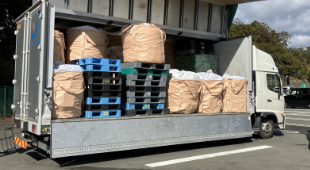
4The collected materials for recycling are picked up by specialized recyclers and used as raw materials for recycled plastics.
BeforeAll plastic cases were disposed of as industrial waste (plastic waste).AfterRigid plastics can now be collected as valuable materials.
Environmentally-Conscious Product Transport
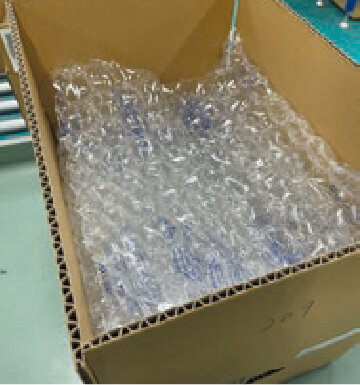
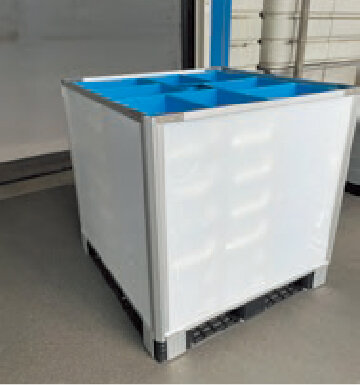
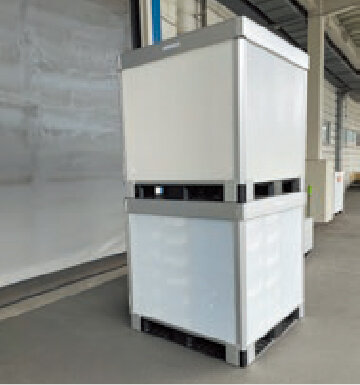
Our logistics departments replaced the cushioning material, which is used when products are transported to our customers, with an environmentally-friendly material. We found a cushioning material that would ensure safe transport and eventually opted for paper packaging for heavy items. After use, the paper packaging can be recycled. Air cushions made by thin film are also used, which do not produce toxic substances when incinerated. Our customers previously commented that cushioning material was bulky and difficult to dispose of. The new air-cushioning material makes it possible to reduce the amount of waste just by letting the air out. Also, we used to wrap pallet cargo with multiple layers of film to prevent the cargo from dislodging during daily shipments from our Shinshiro Factory to Logis Tokyo. However, we have eliminated this method and adopted a new one, which involves covering the entire pallet with a box assembled from five panels. These panels can be used repeatedly, so they reduce waste. As they can also be stacked, additional transport trucks no longer need to be dispatched depending on the volume of cargo. This makes our transport more efficient.
Packaging with paper cushioning material
Packaging with air packing
Cargo loaded on pallet & protected with panels
Use of panels allows for stacking
Eco-Frendly Products and Services
OSG is committed to developing and providing eco-friendly products to our customers.We are actively working to reduce environmental impact by enhancing our regrinding business and developing high-speed cutting, long-life, high-efficiency, and resource-saving products.
Promotion of Carbide Recycling
Tungsten, cobalt, and other rare metals are among the raw materials used in manufacturing carbide tools.
The entire OSG Group has been striving to recycle carbide products. We recover used tools from our customers and recycle the rare metals so that these materials may be reused as part of our efforts to effectively utilize resources. This also is beneficial to our customers in facilitating their CSR activities and achieving zero emissions.
In order to contribute to a recycling society and reuse precious resources, OSG has joined hands with Nihon Hard Metal Co., Ltd. in an effort to recycle hardened tools.
Merits of hardened tool recycling by Nihon Hard Metal Co., Ltd.
As long as the tool has been hardened, it doesn't have to be separated into categories such as end mills, drills, reamers, and tips.
It's okay if the tools contain small amounts of a different material (tools with cermet, ceramic and steel shanks are separated)
Amount of material that can be sent for recycling: 20kg and over (shipping costs are paid by Nihon Hard Metal Co., Ltd.)
Recycling cost: Payment may be made through bank deposit
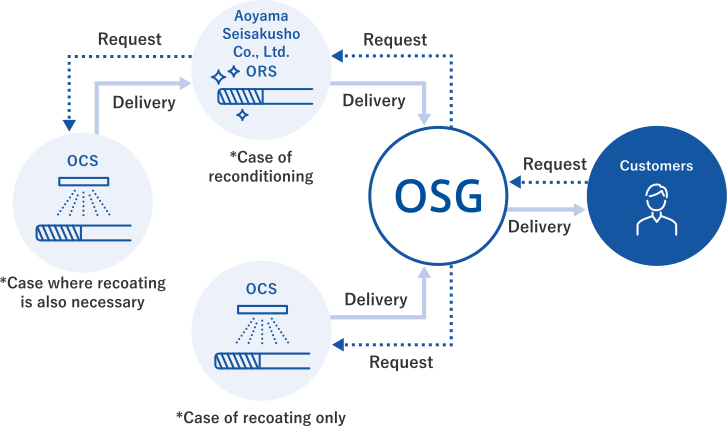
Reconditioning Service
Taps, end mills, drills, and other cutting tools become worn and dull after repeated use.Reconditioning these tools restores their sharpness so they are as good as new. These tools may also be recoated if necessary. OSG Group companies offer reconditioning and recoating services customized to meet our customers' needs.
Environmentally Conscious Product Development
At OSG, we are intent on leveraging cutting tools to solve challenges for customers as we strive for a sustainable society. High quality, highly efficient, and highly durable cutting tools contribute to improving customer productivity and reducing energy consumption.
Going forward, we are committed to developing environmentally conscious products while ecognizing social and environmental issues, and lending our effort--through cutting tools--toward the achievement of a sustainable society.
Showcase: One of Our Environmentally Conscious Products
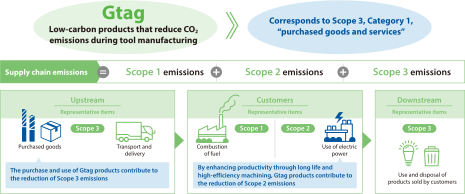
Enabling supply chain emissions reductions that lead to a lower carbon footprint
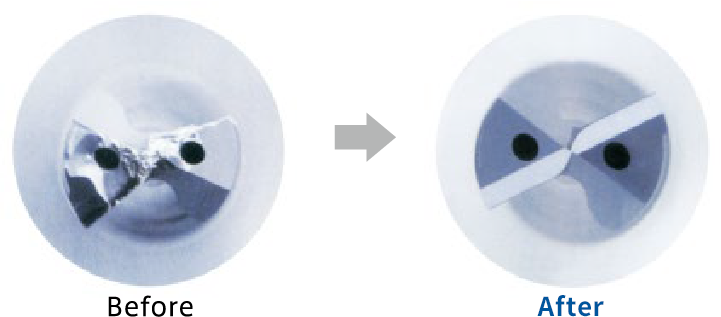
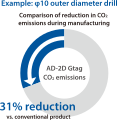
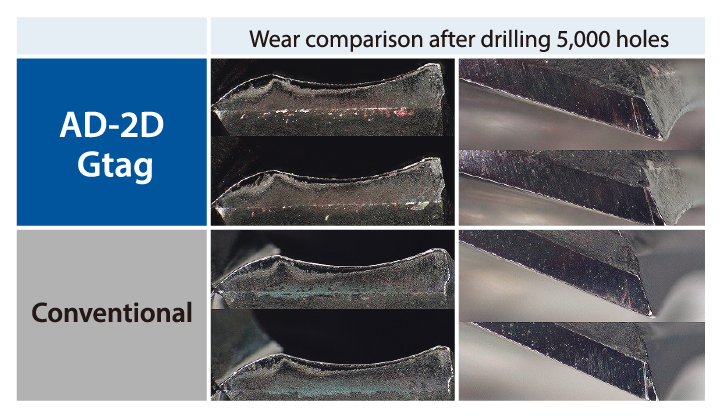
Our Gtag series of low-carbon cutting tools reduce CO2 emissions by 30-35% per tool through a new proprietary manufacturing method that consumes less power during manufacturing. While maintaining machining performance that equals or exceeds that of our conventional products, it helps to reduce CO2 emissions on carbide drill, end mill, and forming tap lines and contributes to reducing environmental impacts across the supply chain.
Low-carbon Carbide Drill
Cutting dataSame performance as conventional product
Tool
AD-2D Gtag φ6
Work Material
S50C
Cutting Speed
90m/min(4,775min-1)
Feed
860mm/min(0.18mm/rev)
Depth of Hole
12 mm (through)
Coolant
Water-soluble Chlorine-free (5%)
Machine
Horizontal Machining Center (HSK-A63)
Message
The development of Gtag products began from the pursuit of enhanced performance, as well as from consideration of how we can protect the manufacturing of the future. Our initiatives to control power consumption during manufacturing and reduce CO2 emissions through proprietary manufacturing methods are essentially an endeavor to fulfill our responsibility to the environment. We realized that offering new ideas a step ahead of the industry is a key step toward creating new value and building a better future with customers.
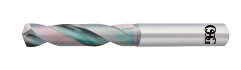
One product exemplifying that approach is the AD-2D Gtag low-carbon carbide drill. This product reduces CO2 emissions during manufacturing while ensuring performance and durability on par with those of our other products, thereby being environmentally conscious without compromising reliability. While maintaining the versatility to handle a wide range of work material, the product directly contributes to reducing CO2 emissions.
By reducing the environmental burden and improving productivity, we hope to contribute to our customers' businesses and to society.
Kazutoyo Ito
Manager, Drill Design and Development Group, Design Center
Safety Data Sheet (SDS)
Please click here. SDS(GHS Classification) is in the "Technical Information" of the "Product" site.



 A Farm-based Off-site PPA
 On-site PPA at Shinshiro Factory
 On-site PPA at Nihon Hard Metal
 On-site PPA at F.P.TOOLS
  Oike Factory - New Factory Building (Exterior)
 Oike Factory - Cafeteria Building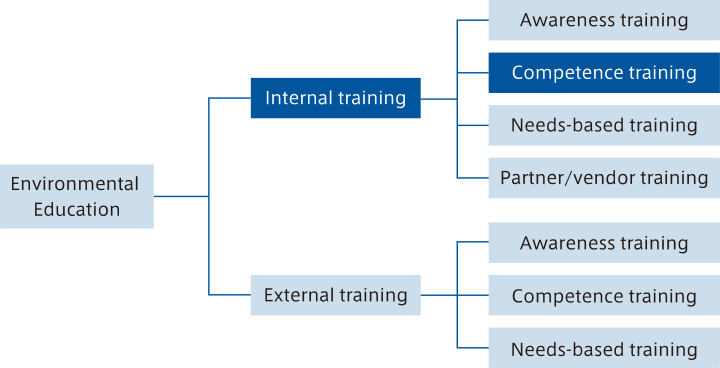








ISO14001
ISO 14001 Certificate(1.1 MB)